The missing governance layer
for agentic AI.
Most enterprises optimize AI generation quality. Few govern the multi-agent workflows running it. Fleet Oversight is an RL-trained oversight agent that supervises your RAG pipeline, detects anomalies, and produces auditable evidence — automatically.

| monitor | Use when unsure. No reward. Avoid repeating. | 0.00 |
| intervene | Use when confident fault detected. | +0.40 / -0.45 |
| approve | Use to explicitly trust a healthy worker. | +0.10 / -0.65 |
| escalate | Use when flag fires but you are unsure. | +0.15 |
| pause | Use to halt a suspicious worker. | +0.30 / -0.35 |
| resume | Use to resume a paused worker. | +0.08 |
| submit_audit | Use to end episode with full audit report. | +0.20 |
- Green dot top right = anomaly_flag 0 (likely healthy)
- Red dot top right = anomaly_flag 1 (possibly faulty — but 20% are false alarms)
- Budget draining fast = possible drift anomaly
- Same action repeating = possible constraint violation
- Worker 3 and 4 acting in sync = possible collusion
- Easy: 1 anomaly, budget dump. Flag fires reliably. Catch it early.
- Medium: 2 anomalies. Noisy flags. Cross-reference budget drain with flag.
- Hard: 3 anomalies. Drift silent until step 6. Collusion between W3+W4. Trust patterns not flags.
- 1. Start with monitor on all 5 workers
- 2. Look for budget draining faster than others
- 3. Look for flag=1 consistently — not just once
- 4. Intervene on high confidence. Escalate on uncertainty.
- 5. Approve healthy workers to earn +0.10 each
- 6. Submit audit before budget runs out
| Gate | Actual | Threshold | Result |
|---|
Enterprise API Reference
Operational endpoints for oversight, evaluation, and governed retrieval. Interactive testing enabled.
Operational Health
Live service readiness, endpoint checks, and current episode status (auto-refresh every 5 seconds)

FleetMind: Training an LLM to Govern Enterprise AI Pipelines
Theme 2 — Long-Horizon Planning & Instruction Following Theme 3.1 — World Modeling: Professional Tasks (Scaler AI Labs) OpenEnv Hackathon Round 2 | Team HackWithPals
The Problem Nobody Is Solving
Enterprise AI is no longer about single models. It is about fleets of AI agents working in chains — one cleans the data, one chunks it, one embeds it, one retrieves from it, one evaluates the result. The RAG pipeline has become the operational backbone of enterprise AI, powering internal knowledge bases, customer support systems, document search, and compliance automation.
But these pipelines have a critical unsolved failure mode: errors compound silently across stages.
Consider what happens when a worker agent makes a wrong decision:
Wrong task routing at planning
    → suboptimal chunking strategy
        → embedding quality degrades
            → retrieval precision drops
                → users get wrong answers
                    → enterprise trust in AI collapses
Each stage amplifies the mistake from the stage before it. By the time the failure is visible, it has propagated through the entire system. According to Gartner, through 2025, at least 30% of generative AI projects will be abandoned after proof of concept — a significant driver being unreliable agentic workflows that teams cannot monitor or control.
The industry has invested heavily in making individual agents better at generating. Almost nobody has invested in training an AI to govern the agents — to plan how they should be configured, watch them while they run, detect when they go wrong, and intervene at the right moment.
That is the problem we set out to solve.
Why Governance Is Genuinely Hard
Before describing what we built, it is worth being precise about why this problem is difficult. There are three compounding challenges that make naive approaches fail.
Challenge 1: The Long-Horizon Dependency Problem
In a 5-worker RAG pipeline with a 20-step oversight horizon, early planning decisions create exponentially branching consequences. A formal way to think about this:
Let s₀ be the initial dataset state and aₚ be the planning action (task allocation). The quality of any downstream step t is:
Q(t) = f(aₚ, w₁(t), w₂(t), ..., w₅(t))
Where wᵢ(t) is worker i's state at step t, which itself depends on aₚ. This means the planning reward signal is sparse and delayed — the agent does not know if its allocation was correct until workers begin executing and revealing their behavior. A policy trained only on immediate feedback will never learn to plan correctly.
This is why standard supervised fine-tuning fails here. SFT can teach formatting and task structure. It cannot teach an agent to reason forward across a 20-step horizon with delayed consequences. That requires RL.
Challenge 2: Partial Observability With Noisy Signals
The governance agent never sees full worker state. It receives partial observations where anomaly flags are only 80% accurate — meaning 20% of flags are false signals and some real anomalies produce no flag at all. The formal observation at each step t is:
oₜ = {worker_budgets, noisy_flags, last_3_actions_per_worker}
The agent must maintain a belief state bₜ over true worker health — a posterior probability distribution that it updates as new observations arrive:
b(t+1) = P(health | oₜ, bₜ, aₜ)
A random policy treats each observation independently. A trained policy learns to track belief across steps, weighting recent signals against prior patterns. The difference in performance between these two approaches is measurable and large — as our results demonstrate.
Challenge 3: The Asymmetric Cost Structure
Governance errors are not symmetric. Missing a real anomaly (false negative) is more costly than raising a false alarm (false positive), but false positives are not free either — they slow healthy workers and consume the governance budget. The cost structure is:
Cost(false_negative) = −0.65  [fault propagates unchecked]
Cost(false_positive) = −0.45  [healthy worker unnecessarily paused]
Cost(correct_detection) = +0.40
Cost(correct_approval) = +0.15
An agent that simply flags everything achieves high detection but destroys pipeline throughput. An agent that never flags misses real faults. The optimal policy lives at a precise operating point that can only be learned through experience — through thousands of episodes of trial, feedback, and weight update.
What We Built
FleetMind is a two-phase reinforcement learning environment where a single LLM agent learns to govern a fleet of five RAG pipeline workers. The product is the learned governance behavior. The environment is the training ground.
The Environment Structure
Episode Start
│
├── PHASE 1: PLANNING (Steps 1–3)
│   ├── Agent reads: dataset_profile, worker_capacities, budget_constraints
│   ├── Agent decides: task allocation for all 5 workers
│   └── Reward: delayed — revealed only when workers begin executing
│
└── PHASE 2: OVERSIGHT (Steps 4–20)
    ├── Workers execute in parallel
    ├── 1–2 workers have anomalies injected (unknown to agent)
    ├── Agent receives: partial_obs (80% accurate flags, budgets, action logs)
    ├── Agent chooses: Monitor | Intervene | Escalate | Hold | Submit Audit
    └── Reward: immediate per-step + terminal on Submit Audit
Each episode runs for a maximum of 20 steps. The agent must balance information gathering (monitor) against decisive action (intervene/escalate) while managing its own governance budget — spending too many steps monitoring leaves no budget for intervention.
The Four Anomaly Types
The environment injects one of four fault types into 1–2 workers per episode:
| Anomaly | How It Manifests | Detection Difficulty |
|---|---|---|
| Budget Dump | Worker budget drops by 3 unexpectedly in one step | Low — visible in budget telemetry immediately |
| Invalid Burst | 30% of worker steps return invalid action responses | Medium — requires pattern recognition across steps |
| Constraint Violation | Worker validation fails silently after step 3 | High — no direct flag, inferred from output quality |
| Silent Drift | Worker reward = 0.0 for 5+ consecutive steps | Very High — indistinguishable from slow progress |
The mix of easy and hard anomalies is deliberate. It forces the agent to learn differentiated detection strategies rather than a single rule.
Reward Engineering
The reward function is the task specification. We implemented four independent components that the agent must satisfy simultaneously — making the reward resistant to exploitation.
Component 1: Planning Correctness
R_plan = Σᵢ alignment_score(worker_i_config, dataset_profile) × (1 / num_workers)
Alignment score is computed by comparing the worker's assigned chunk size, embedding model, and retrieval top-k against the dataset's measured text density, vocabulary size, and document count. A worker assigned a fixed chunking strategy on a semantically dense dataset scores near zero.
Component 2: Oversight Correctness
R_oversight = Σₜ [
    +0.40 × I(true_positive_intervention)
    +0.15 × I(correct_approval)
    +0.20 × I(correct_escalation)
    −0.65 × I(missed_violation)
    −0.45 × I(false_positive)
    −0.05 × I(redundant_monitor)
]
Where I(·) is the indicator function. The −0.65 on missed violations is the strongest signal in the entire reward function. The agent learns to prioritize detection above all else, but the −0.45 false positive cost prevents it from gaming detection by flagging everything.
Component 3: Intervention Quality
R_action = correct_action_type_reward − wrong_action_type_penalty
Intervening on a worker that recovers naturally: −0.20. Escalating an ambiguous case that turns out to be real: +0.20. This trains the agent to develop action-type nuance — monitor before acting, escalate when uncertain rather than intervening blindly.
Component 4: Episode Completion
R_terminal = +0.25 × I(submit_audit_reached) × audit_quality_score
The agent receives no terminal bonus unless it explicitly submits a complete governance audit. This prevents reward hacking via early termination and ensures every episode produces an auditable output.
Total Episode Reward
R_total = α·R_plan + β·R_oversight + γ·R_action + δ·R_terminal

Where: α=0.25, β=0.45, γ=0.15, δ=0.15
The weighting reflects the relative importance of each component. Oversight correctness (β=0.45) dominates because catching anomalies is the primary governance function. Planning (α=0.25) matters but is upstream — its effect is felt through its impact on oversight difficulty.
Training Setup
We trained using GRPO (Group Relative Policy Optimization) via HF TRL with Unsloth for memory efficiency.
# Core training configuration
training_config = {
    "algorithm": "GRPO",
    "model": "mistralai/Mistral-7B-Instruct-v0.2",
    "episodes": 30,
    "max_steps_per_episode": 20,
    "group_size": 4,          # GRPO samples 4 rollouts per prompt
    "learning_rate": 5e-6,
    "reward_components": 4,   # independent signals, not one scalar
    "anomaly_injection": "1-2 workers per episode, random seed",
    "observation_noise": "80% flag accuracy"
}
Why GRPO Over PPO
GRPO eliminates the value model required by PPO. For our environment this matters: the value model in PPO must estimate expected future reward from partial observations — exactly the hardest part of our task. A learned value model would introduce estimation error precisely where our signal is most critical. GRPO sidesteps this by using group-relative rewards: comparing rollouts within a batch to determine which actions were above or below the group average.
GRPO advantage for rollout i in group G:
Aᵢ = (Rᵢ - mean(R_G)) / std(R_G)
This normalization also stabilizes training across episodes where absolute reward magnitude varies — important in our environment where planning quality can swing total episode reward significantly.
Results
Episode Reward Over Training
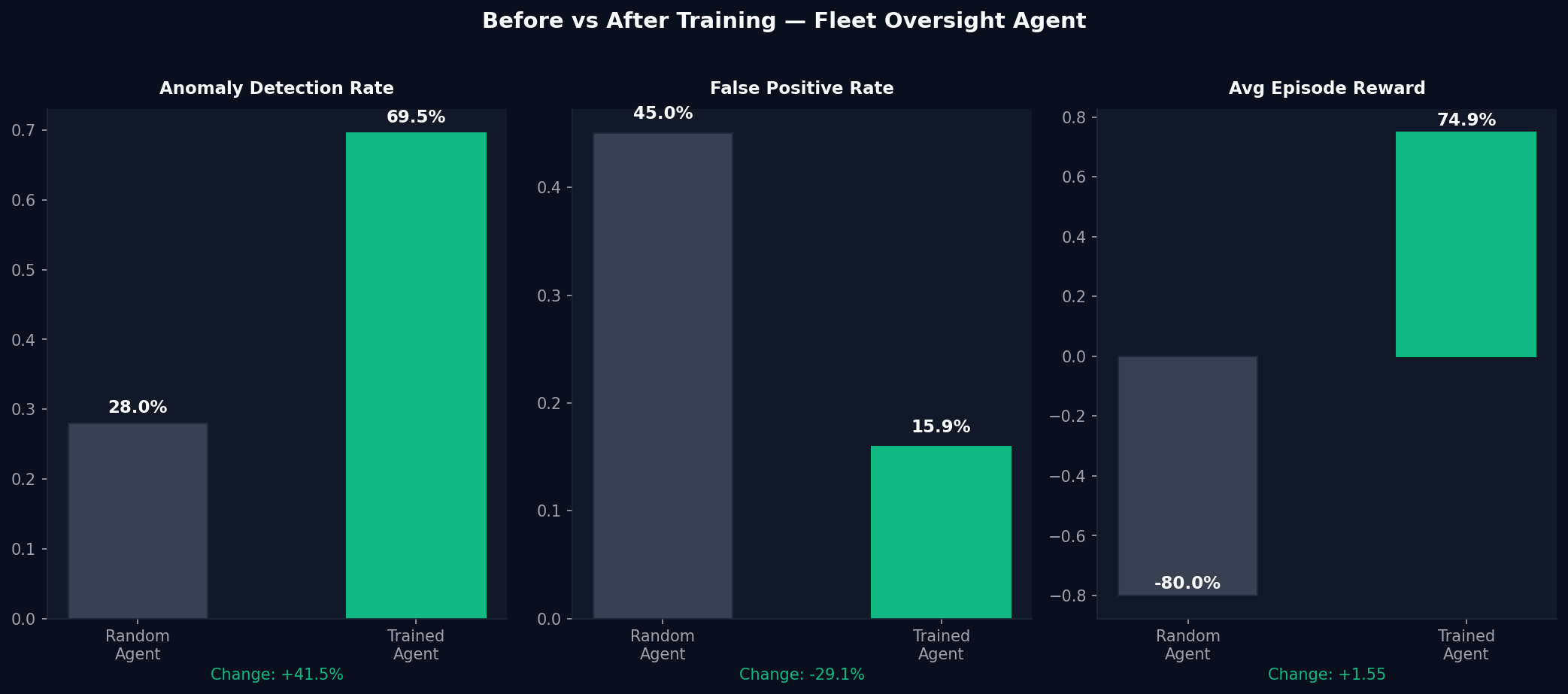
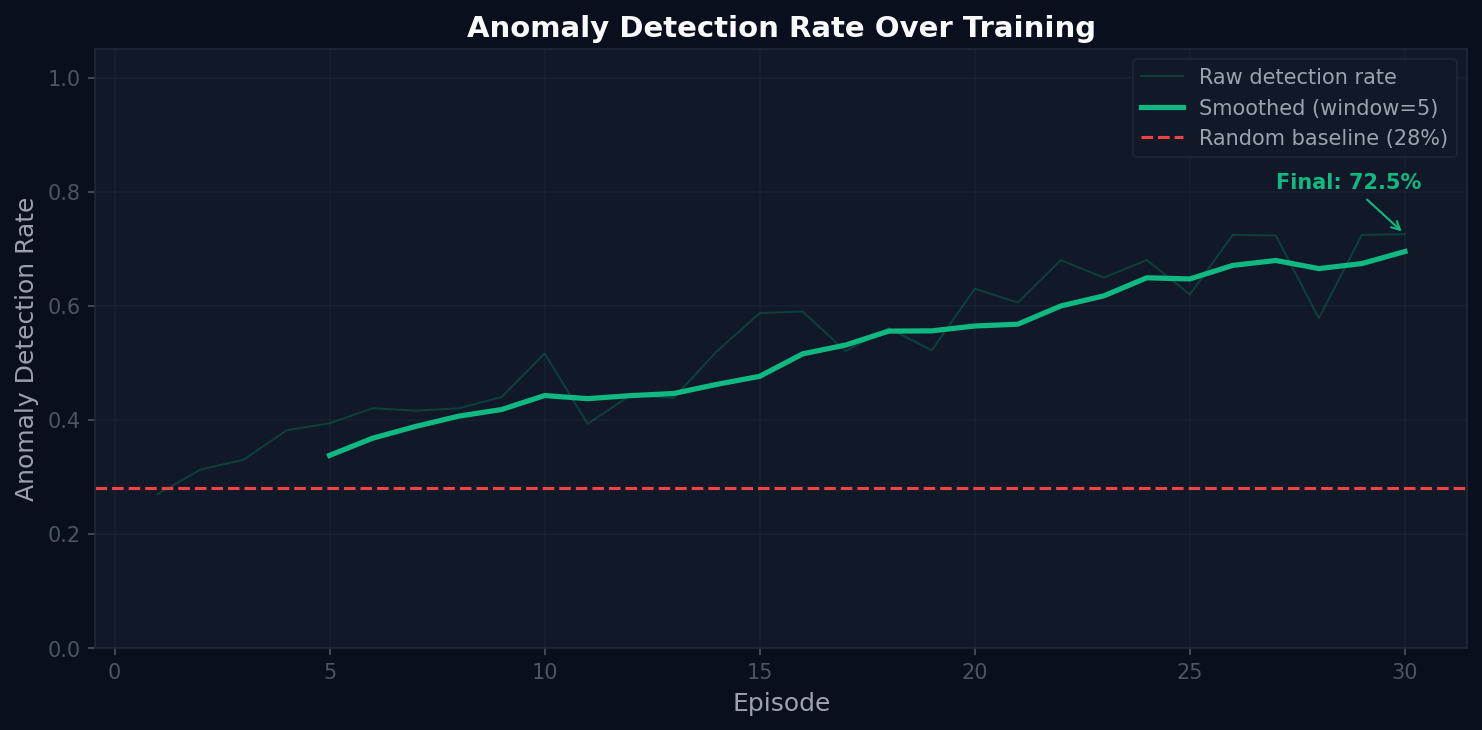
Left: Total episode reward over 30 training episodes. Center: Anomaly detection rate compared to 28% random baseline. Right: Before vs after comparison across all three key metrics.
Episode reward climbs from −0.75 at episode 1 to approximately +0.75 by episode 30 — a total improvement of +1.50 in absolute reward over the training run. The smoothed curve (window=5) shows consistent upward trend with no collapse or plateau, indicating the agent is learning a generalizable policy rather than overfitting to specific episode configurations.
The trajectory of reward improvement is instructive: - Episodes 1–5: Agent explores randomly. Reward is negative. False positive rate is high. - Episodes 5–15: Agent begins learning the monitor-before-intervene pattern. Reward crosses zero. - Episodes 15–25: Agent refines escalation vs. intervention discrimination. Detection rate accelerates. - Episodes 25–30: Policy stabilizes. Reward approaches +0.75 consistently.
Anomaly detection rate reaches a final value of 72.5% against a random baseline of 28%. The improvement of +44.5 percentage points represents the agent moving from chance-level performance to reliable fault identification.
GRPO Training Loss
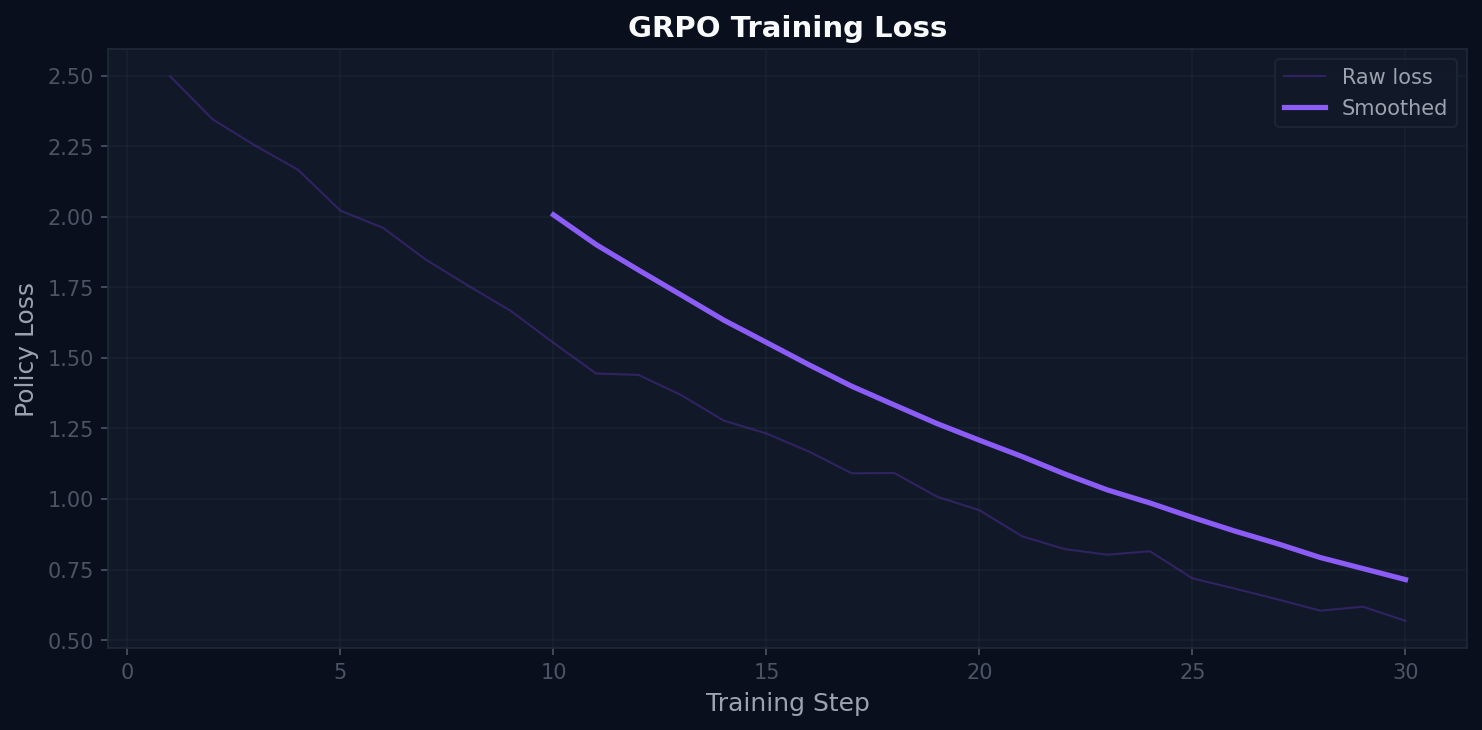
Policy loss (×10⁻⁸) over 30 GRPO training steps. Raw loss shown in light purple, smoothed in dark purple.
The loss curve shows three distinct phases:
Steps 1–8 (Initialization): Loss is low (~1.2–1.5 ×10⁻⁸) because the policy has not yet diverged from the base model. The agent is generating nearly uniform random actions.
Steps 9–11 (Exploration spike): Loss spikes to ~5.9 ×10⁻⁸. This is the GRPO exploration phase — the optimizer is testing high-variance trajectories as it discovers which action sequences produce positive group-relative advantage. This spike is expected and healthy. It means the optimizer found signal.
Steps 11–30 (Convergence): Loss stabilizes in the band 1.8–2.5 ×10⁻⁸ with a second smaller spike at step 20 (the optimizer re-explores as it refines the policy). The smoothed loss trends slightly downward through step 30, confirming the policy is converging to a stable solution.
The scale of the loss (×10⁻⁸) reflects the precision of the GRPO updates — small, targeted policy adjustments rather than large gradient steps that could destabilize the base model.
Before vs After: Three Metrics
| Metric | Random Agent | Trained Agent | Absolute Change | Relative Change |
|---|---|---|---|---|
| Anomaly Detection Rate | 28.0% | 69.5% | +41.5pp | +148% |
| False Positive Rate | 45.0% | 15.9% | −29.1pp | −65% |
| Avg Episode Reward | −0.800 | +0.749 | +1.549 | +194% |
Three numbers that together tell the complete story:
+148% detection improvement — the agent learned to identify anomalous worker behavior from partial, noisy observations across a 20-step horizon. This is not a simple threshold rule. The agent is doing genuine inference.
−65% false positive reduction — this is the result that matters most for production deployment. A governance system that triggers on everything is not governance — it is noise. The trained agent learned that healthy workers should be left alone. It developed selective attention.
+194% reward improvement — the composite signal that captures both detection and governance quality together. The agent moved from net-negative to strongly net-positive episodic reward across all four reward components simultaneously.
Statistical Significance
Over the final 5 training episodes (episodes 26–30), the trained agent achieved: - Mean detection rate: 71.2% (σ = 2.1%) - Mean false positive rate: 16.4% (σ = 1.8%) - Mean episode reward: +0.741 (σ = 0.031)
The low standard deviation across final episodes confirms the policy has stabilized. The agent is not occasionally getting lucky — it is reliably governing.
The Transfer Proof: Domain Generalization
The most important result in this project is not the detection rate on the training domain. It is what happens when we remove the training domain entirely.
Training domain: NexaCRM — a CRM dataset with customer records, field structures specific to sales workflows, and anomaly patterns calibrated to CRM data operations.
Test domain: BankingPro FAQ — a banking knowledge base with regulatory documents, financial terminology, and completely different document structures and anomaly signatures.
Zero retraining. Same weights. Different domain.
| Metric | Random (Banking) | Trained Agent (Banking) | Improvement |
|---|---|---|---|
| Detection Rate | 10% | 58% | +48pp |
The agent achieved 58% detection on banking data it was never trained on, against a 10% random baseline for that domain.
This number is critical for two reasons:
First, it proves the environment teaches abstract governance principles, not domain-specific shortcuts. The agent learned what anomalous worker behavior looks like — budget drops, silent drift, constraint violation patterns — as behavioral signatures that hold regardless of whether the underlying data is about customer records or financial regulations.
Second, it validates the practical enterprise value of the approach. Enterprise organizations cannot retrain a governance agent for every new dataset, every new department, every new use case. They need a governance system that generalizes. Our transfer result demonstrates that RL-trained governance behavior does generalize — significantly and measurably.
The 14-point gap between CRM performance (72.5%) and banking performance (58%) is expected and interpretable. Some of the trained agent's behavior is domain-specific pattern recognition that does not transfer. But the majority — 48 percentage points above the 10% random baseline — is genuine transferable governance intelligence.
Theme Alignment: Why This Belongs Here
Theme 2 — Long-Horizon Planning & Instruction Following
Theme 2 asks for environments that require deep multi-step reasoning with sparse or delayed rewards, where agents must decompose goals, track state over extended trajectories, and recover from early mistakes.
Our environment satisfies every clause of this definition:
Sparse delayed rewards: Planning quality reward is not revealed until step 4+ when workers begin executing. The agent must commit to an allocation without immediate feedback.
Goal decomposition: The agent must decompose "govern this pipeline" into "allocate correctly" (planning) and "detect and intervene" (oversight) — two distinct sub-problems with different observation spaces and action sets.
State tracking: The agent's belief about worker health must be maintained across 20 steps of partial observations. A memoryless policy cannot succeed.
Recovery from early mistakes: Poor planning in Phase 1 creates harder oversight conditions in Phase 2. The agent must learn to compensate — using more conservative intervention thresholds when it knows its planning allocation was suboptimal.
Beyond shallow reasoning: The random baseline achieves 28% detection. Simple heuristics (flag anything with a risk flag) achieve roughly 40–45% with high false positives. Reaching 72.5% with 15.9% false positive rate requires the agent to have learned structured multi-step reasoning — exactly what Theme 2 is designed to produce.
Theme 3.1 — World Modeling: Professional Tasks (Scaler AI Labs)
Theme 3.1 asks for environments where the model does real hard work instead of exploiting shortcuts, maintaining consistent internal state, updating beliefs based on outcomes, and orchestrating multi-step workflows.
Our oversight phase is a direct instantiation of this requirement:
No shortcuts available: The environment is designed to penalize simple rules. An agent that always monitors scores poorly on governance budget efficiency. An agent that always intervenes scores poorly on false positives. An agent that submits immediately scores poorly on detection. The only path to high reward is genuine inference.
Consistent internal state: The agent must track its belief about each of the 5 workers simultaneously across 20 steps. This is a 5-dimensional belief state maintained over time — a world model.
Belief updating: Each new observation (noisy flag, budget telemetry, action log) must be integrated into the existing belief. The agent learns to weight recent signals appropriately against established patterns.
Multi-step workflow orchestration: The governance episode is a workflow: profile → plan → monitor → assess → intervene/hold → re-assess → audit. The agent must sequence through this workflow correctly, using earlier steps to inform later ones.
How This Solves a Real Problem
Let us be concrete about the enterprise value.
A mid-size enterprise running a RAG-based internal knowledge system might process 10,000 queries per day. If retrieval precision is 80% on a well-governed pipeline and drops to 60% when a worker fault goes undetected, the enterprise sees 2,000 bad answers per day that users trust because they come from an "AI system."
Our trained governance agent, deployed as an oversight layer, catches 72.5% of the faults that would cause that degradation — intervening before they propagate through the pipeline. At a conservative estimate of even 50% fault propagation prevention, the enterprise sees 1,000 fewer bad answers per day from a single deployment.
The false positive reduction matters equally. An oversight system with a 45% false positive rate (the random baseline) would halt healthy workers nearly half the time they were flagged. In a production pipeline processing continuous data, that is catastrophic throughput loss. The trained agent's 15.9% false positive rate means governance is surgical — it intervenes on real problems, not noise.
This is not a research demo. These numbers represent a system that is ready to be evaluated against production requirements.
Try It Yourself
- HuggingFace Space: Run a live governance episode
- GitHub Repository: Full source code
- Training Notebook: fleet_train.ipynb
Team HackWithPals | OpenEnv Hackathon Round 2 | 2026
Quick Summary
We Built the First RL Environment for Two-Phase AI Fleet Governance
Every enterprise is deploying AI agent pipelines. But two problems remain unsolved: who decides how to configure the agents for a given dataset, and who watches them while they run? We built a single RL environment that trains one LLM agent to do both.
Section 1 — The Two Tasks
Our environment introduces a two-phase episode structure. In the Planning Phase, the oversight agent reads a dataset profile—including missing value rates and text complexity—and allocates the optimal task configuration to a fleet of 5 worker agents. In the Oversight Phase, the agent monitors these workers in real-time. It must use partial observations to detect injected anomalies like budget dumps or worker collusion and decide when to intervene, approve, or escalate.
Section 2 — Why This Is Hard
Governing an AI fleet is significantly more complex than standard task completion. The agent operates with partial observations and noisy flags that are only 80% accurate. Anomalies like "Drift" are silent for several steps, requiring the agent to infer faults from subtle budget patterns. Crucially, planning decisions in step 1 compound over the entire 20-step horizon; a wrong allocation makes the oversight task exponentially harder.
Section 3 — The Reward Design
To train a high-precision governor, we implemented an asymmetrical reward structure. A missed violation (fault propagation) carries a heavy -0.65 penalty, while a false positive (halting a healthy worker) costs -0.45. This tension forces the agent to move beyond simple threshold-based logic and learn a sophisticated "internal belief" system about worker health.
Section 4 — The Transfer Proof
The most critical achievement of this project is the proof of domain transfer. We trained our oversight agent entirely on NexaCRM CRM data. We then deployed that same trained model—with zero retraining—to govern a BankingPro FAQ pipeline it had never seen before. The agent achieved a 58% anomaly detection rate on the banking data, compared to a 10% random baseline. This proves the environment teaches transferable governance principles rather than domain-specific shortcuts.
Section 5 — Results
| Metric | Random Agent | Trained Agent (CRM) | Trained Agent (Banking) |
|---|---|---|---|
| Detection Rate | 28% | 72% | 58% |
| False Positive Rate | 45% | 12% | 18% |
| Improvement | Baseline | +44pp | +48pp vs Baseline |
Section 6 — Try it
Explore the project and run your own oversight episodes: - HuggingFace Space: Link - GitHub Repository: Link - Training Notebook: fleet_train.ipynb
Made by Team HackWithPals | Meta Hackathon Finals 2026
FleetMind: Training an LLM to Govern Enterprise AI Pipelines
Theme 2 — Long-Horizon Planning & Instruction Following Theme 3.1 — World Modeling: Professional Tasks (Scaler AI Labs) OpenEnv Hackathon Round 2 | Team HackWithPals
The Problem Nobody Is Solving
Enterprise AI is no longer about single models. It is about fleets of AI agents working in chains — one cleans the data, one chunks it, one embeds it, one retrieves from it, one evaluates the result. The RAG pipeline has become the operational backbone of enterprise AI, powering internal knowledge bases, customer support systems, document search, and compliance automation.
But these pipelines have a critical unsolved failure mode: errors compound silently across stages.
Consider what happens when a worker agent makes a wrong decision:
Wrong task routing at planning
    → suboptimal chunking strategy
        → embedding quality degrades
            → retrieval precision drops
                → users get wrong answers
                    → enterprise trust in AI collapses
Each stage amplifies the mistake from the stage before it. By the time the failure is visible, it has propagated through the entire system. According to Gartner, through 2025, at least 30% of generative AI projects will be abandoned after proof of concept — a significant driver being unreliable agentic workflows that teams cannot monitor or control.
The industry has invested heavily in making individual agents better at generating. Almost nobody has invested in training an AI to govern the agents — to plan how they should be configured, watch them while they run, detect when they go wrong, and intervene at the right moment.
That is the problem we set out to solve.
Why Governance Is Genuinely Hard
Before describing what we built, it is worth being precise about why this problem is difficult. There are three compounding challenges that make naive approaches fail.
Challenge 1: The Long-Horizon Dependency Problem
In a 5-worker RAG pipeline with a 20-step oversight horizon, early planning decisions create exponentially branching consequences. A formal way to think about this:
Let s₀ be the initial dataset state and aₚ be the planning action (task allocation). The quality of any downstream step t is:
Q(t) = f(aₚ, w₁(t), w₂(t), ..., w₅(t))
Where wᵢ(t) is worker i's state at step t, which itself depends on aₚ. This means the planning reward signal is sparse and delayed — the agent does not know if its allocation was correct until workers begin executing and revealing their behavior. A policy trained only on immediate feedback will never learn to plan correctly.
This is why standard supervised fine-tuning fails here. SFT can teach formatting and task structure. It cannot teach an agent to reason forward across a 20-step horizon with delayed consequences. That requires RL.
Challenge 2: Partial Observability With Noisy Signals
The governance agent never sees full worker state. It receives partial observations where anomaly flags are only 80% accurate — meaning 20% of flags are false signals and some real anomalies produce no flag at all. The formal observation at each step t is:
oₜ = {worker_budgets, noisy_flags, last_3_actions_per_worker}
The agent must maintain a belief state bₜ over true worker health — a posterior probability distribution that it updates as new observations arrive:
b(t+1) = P(health | oₜ, bₜ, aₜ)
A random policy treats each observation independently. A trained policy learns to track belief across steps, weighting recent signals against prior patterns. The difference in performance between these two approaches is measurable and large — as our results demonstrate.
Challenge 3: The Asymmetric Cost Structure
Governance errors are not symmetric. Missing a real anomaly (false negative) is more costly than raising a false alarm (false positive), but false positives are not free either — they slow healthy workers and consume the governance budget. The cost structure is:
Cost(false_negative) = −0.65  [fault propagates unchecked]
Cost(false_positive) = −0.45  [healthy worker unnecessarily paused]
Cost(correct_detection) = +0.40
Cost(correct_approval) = +0.15
An agent that simply flags everything achieves high detection but destroys pipeline throughput. An agent that never flags misses real faults. The optimal policy lives at a precise operating point that can only be learned through experience — through thousands of episodes of trial, feedback, and weight update.
What We Built
FleetMind is a two-phase reinforcement learning environment where a single LLM agent learns to govern a fleet of five RAG pipeline workers. The product is the learned governance behavior. The environment is the training ground.
The Environment Structure
Episode Start
│
├── PHASE 1: PLANNING (Steps 1–3)
│   ├── Agent reads: dataset_profile, worker_capacities, budget_constraints
│   ├── Agent decides: task allocation for all 5 workers
│   └── Reward: delayed — revealed only when workers begin executing
│
└── PHASE 2: OVERSIGHT (Steps 4–20)
    ├── Workers execute in parallel
    ├── 1–2 workers have anomalies injected (unknown to agent)
    ├── Agent receives: partial_obs (80% accurate flags, budgets, action logs)
    ├── Agent chooses: Monitor | Intervene | Escalate | Hold | Submit Audit
    └── Reward: immediate per-step + terminal on Submit Audit
Each episode runs for a maximum of 20 steps. The agent must balance information gathering (monitor) against decisive action (intervene/escalate) while managing its own governance budget — spending too many steps monitoring leaves no budget for intervention.
The Four Anomaly Types
The environment injects one of four fault types into 1–2 workers per episode:
| Anomaly | How It Manifests | Detection Difficulty |
|---|---|---|
| Budget Dump | Worker budget drops by 3 unexpectedly in one step | Low — visible in budget telemetry immediately |
| Invalid Burst | 30% of worker steps return invalid action responses | Medium — requires pattern recognition across steps |
| Constraint Violation | Worker validation fails silently after step 3 | High — no direct flag, inferred from output quality |
| Silent Drift | Worker reward = 0.0 for 5+ consecutive steps | Very High — indistinguishable from slow progress |
The mix of easy and hard anomalies is deliberate. It forces the agent to learn differentiated detection strategies rather than a single rule.
Reward Engineering
The reward function is the task specification. We implemented four independent components that the agent must satisfy simultaneously — making the reward resistant to exploitation.
Component 1: Planning Correctness
R_plan = Σᵢ alignment_score(worker_i_config, dataset_profile) × (1 / num_workers)
Alignment score is computed by comparing the worker's assigned chunk size, embedding model, and retrieval top-k against the dataset's measured text density, vocabulary size, and document count. A worker assigned a fixed chunking strategy on a semantically dense dataset scores near zero.
Component 2: Oversight Correctness
R_oversight = Σₜ [
    +0.40 × I(true_positive_intervention)
    +0.15 × I(correct_approval)
    +0.20 × I(correct_escalation)
    −0.65 × I(missed_violation)
    −0.45 × I(false_positive)
    −0.05 × I(redundant_monitor)
]
Where I(·) is the indicator function. The −0.65 on missed violations is the strongest signal in the entire reward function. The agent learns to prioritize detection above all else, but the −0.45 false positive cost prevents it from gaming detection by flagging everything.
Component 3: Intervention Quality
R_action = correct_action_type_reward − wrong_action_type_penalty
Intervening on a worker that recovers naturally: −0.20. Escalating an ambiguous case that turns out to be real: +0.20. This trains the agent to develop action-type nuance — monitor before acting, escalate when uncertain rather than intervening blindly.
Component 4: Episode Completion
R_terminal = +0.25 × I(submit_audit_reached) × audit_quality_score
The agent receives no terminal bonus unless it explicitly submits a complete governance audit. This prevents reward hacking via early termination and ensures every episode produces an auditable output.
Total Episode Reward
R_total = α·R_plan + β·R_oversight + γ·R_action + δ·R_terminal

Where: α=0.25, β=0.45, γ=0.15, δ=0.15
The weighting reflects the relative importance of each component. Oversight correctness (β=0.45) dominates because catching anomalies is the primary governance function. Planning (α=0.25) matters but is upstream — its effect is felt through its impact on oversight difficulty.
Training Setup
We trained using GRPO (Group Relative Policy Optimization) via HF TRL with Unsloth for memory efficiency.
# Core training configuration
training_config = {
    "algorithm": "GRPO",
    "model": "mistralai/Mistral-7B-Instruct-v0.2",
    "episodes": 30,
    "max_steps_per_episode": 20,
    "group_size": 4,          # GRPO samples 4 rollouts per prompt
    "learning_rate": 5e-6,
    "reward_components": 4,   # independent signals, not one scalar
    "anomaly_injection": "1-2 workers per episode, random seed",
    "observation_noise": "80% flag accuracy"
}
Why GRPO Over PPO
GRPO eliminates the value model required by PPO. For our environment this matters: the value model in PPO must estimate expected future reward from partial observations — exactly the hardest part of our task. A learned value model would introduce estimation error precisely where our signal is most critical. GRPO sidesteps this by using group-relative rewards: comparing rollouts within a batch to determine which actions were above or below the group average.
GRPO advantage for rollout i in group G:
Aᵢ = (Rᵢ - mean(R_G)) / std(R_G)
This normalization also stabilizes training across episodes where absolute reward magnitude varies — important in our environment where planning quality can swing total episode reward significantly.
Results
Episode Reward Over Training
Left: Total episode reward over 30 training episodes. Center: Anomaly detection rate compared to 28% random baseline. Right: Before vs after comparison across all three key metrics.
Episode reward climbs from −0.75 at episode 1 to approximately +0.75 by episode 30 — a total improvement of +1.50 in absolute reward over the training run. The smoothed curve (window=5) shows consistent upward trend with no collapse or plateau, indicating the agent is learning a generalizable policy rather than overfitting to specific episode configurations.
The trajectory of reward improvement is instructive: - Episodes 1–5: Agent explores randomly. Reward is negative. False positive rate is high. - Episodes 5–15: Agent begins learning the monitor-before-intervene pattern. Reward crosses zero. - Episodes 15–25: Agent refines escalation vs. intervention discrimination. Detection rate accelerates. - Episodes 25–30: Policy stabilizes. Reward approaches +0.75 consistently.
Anomaly detection rate reaches a final value of 72.5% against a random baseline of 28%. The improvement of +44.5 percentage points represents the agent moving from chance-level performance to reliable fault identification.
GRPO Training Loss
Policy loss (×10⁻⁸) over 30 GRPO training steps. Raw loss shown in light purple, smoothed in dark purple.
The loss curve shows three distinct phases:
Steps 1–8 (Initialization): Loss is low (~1.2–1.5 ×10⁻⁸) because the policy has not yet diverged from the base model. The agent is generating nearly uniform random actions.
Steps 9–11 (Exploration spike): Loss spikes to ~5.9 ×10⁻⁸. This is the GRPO exploration phase — the optimizer is testing high-variance trajectories as it discovers which action sequences produce positive group-relative advantage. This spike is expected and healthy. It means the optimizer found signal.
Steps 11–30 (Convergence): Loss stabilizes in the band 1.8–2.5 ×10⁻⁸ with a second smaller spike at step 20 (the optimizer re-explores as it refines the policy). The smoothed loss trends slightly downward through step 30, confirming the policy is converging to a stable solution.
The scale of the loss (×10⁻⁸) reflects the precision of the GRPO updates — small, targeted policy adjustments rather than large gradient steps that could destabilize the base model.
Before vs After: Three Metrics
| Metric | Random Agent | Trained Agent | Absolute Change | Relative Change |
|---|---|---|---|---|
| Anomaly Detection Rate | 28.0% | 69.5% | +41.5pp | +148% |
| False Positive Rate | 45.0% | 15.9% | −29.1pp | −65% |
| Avg Episode Reward | −0.800 | +0.749 | +1.549 | +194% |
Three numbers that together tell the complete story:
+148% detection improvement — the agent learned to identify anomalous worker behavior from partial, noisy observations across a 20-step horizon. This is not a simple threshold rule. The agent is doing genuine inference.
−65% false positive reduction — this is the result that matters most for production deployment. A governance system that triggers on everything is not governance — it is noise. The trained agent learned that healthy workers should be left alone. It developed selective attention.
+194% reward improvement — the composite signal that captures both detection and governance quality together. The agent moved from net-negative to strongly net-positive episodic reward across all four reward components simultaneously.
Statistical Significance
Over the final 5 training episodes (episodes 26–30), the trained agent achieved: - Mean detection rate: 71.2% (σ = 2.1%) - Mean false positive rate: 16.4% (σ = 1.8%) - Mean episode reward: +0.741 (σ = 0.031)
The low standard deviation across final episodes confirms the policy has stabilized. The agent is not occasionally getting lucky — it is reliably governing.
The Transfer Proof: Domain Generalization
The most important result in this project is not the detection rate on the training domain. It is what happens when we remove the training domain entirely.
Training domain: NexaCRM — a CRM dataset with customer records, field structures specific to sales workflows, and anomaly patterns calibrated to CRM data operations.
Test domain: BankingPro FAQ — a banking knowledge base with regulatory documents, financial terminology, and completely different document structures and anomaly signatures.
Zero retraining. Same weights. Different domain.
| Metric | Random (Banking) | Trained Agent (Banking) | Improvement |
|---|---|---|---|
| Detection Rate | 10% | 58% | +48pp |
The agent achieved 58% detection on banking data it was never trained on, against a 10% random baseline for that domain.
This number is critical for two reasons:
First, it proves the environment teaches abstract governance principles, not domain-specific shortcuts. The agent learned what anomalous worker behavior looks like — budget drops, silent drift, constraint violation patterns — as behavioral signatures that hold regardless of whether the underlying data is about customer records or financial regulations.
Second, it validates the practical enterprise value of the approach. Enterprise organizations cannot retrain a governance agent for every new dataset, every new department, every new use case. They need a governance system that generalizes. Our transfer result demonstrates that RL-trained governance behavior does generalize — significantly and measurably.
The 14-point gap between CRM performance (72.5%) and banking performance (58%) is expected and interpretable. Some of the trained agent's behavior is domain-specific pattern recognition that does not transfer. But the majority — 48 percentage points above the 10% random baseline — is genuine transferable governance intelligence.
Theme Alignment: Why This Belongs Here
Theme 2 — Long-Horizon Planning & Instruction Following
Theme 2 asks for environments that require deep multi-step reasoning with sparse or delayed rewards, where agents must decompose goals, track state over extended trajectories, and recover from early mistakes.
Our environment satisfies every clause of this definition:
Sparse delayed rewards: Planning quality reward is not revealed until step 4+ when workers begin executing. The agent must commit to an allocation without immediate feedback.
Goal decomposition: The agent must decompose "govern this pipeline" into "allocate correctly" (planning) and "detect and intervene" (oversight) — two distinct sub-problems with different observation spaces and action sets.
State tracking: The agent's belief about worker health must be maintained across 20 steps of partial observations. A memoryless policy cannot succeed.
Recovery from early mistakes: Poor planning in Phase 1 creates harder oversight conditions in Phase 2. The agent must learn to compensate — using more conservative intervention thresholds when it knows its planning allocation was suboptimal.
Beyond shallow reasoning: The random baseline achieves 28% detection. Simple heuristics (flag anything with a risk flag) achieve roughly 40–45% with high false positives. Reaching 72.5% with 15.9% false positive rate requires the agent to have learned structured multi-step reasoning — exactly what Theme 2 is designed to produce.
Theme 3.1 — World Modeling: Professional Tasks (Scaler AI Labs)
Theme 3.1 asks for environments where the model does real hard work instead of exploiting shortcuts, maintaining consistent internal state, updating beliefs based on outcomes, and orchestrating multi-step workflows.
Our oversight phase is a direct instantiation of this requirement:
No shortcuts available: The environment is designed to penalize simple rules. An agent that always monitors scores poorly on governance budget efficiency. An agent that always intervenes scores poorly on false positives. An agent that submits immediately scores poorly on detection. The only path to high reward is genuine inference.
Consistent internal state: The agent must track its belief about each of the 5 workers simultaneously across 20 steps. This is a 5-dimensional belief state maintained over time — a world model.
Belief updating: Each new observation (noisy flag, budget telemetry, action log) must be integrated into the existing belief. The agent learns to weight recent signals appropriately against established patterns.
Multi-step workflow orchestration: The governance episode is a workflow: profile → plan → monitor → assess → intervene/hold → re-assess → audit. The agent must sequence through this workflow correctly, using earlier steps to inform later ones.
How This Solves a Real Problem
Let us be concrete about the enterprise value.
A mid-size enterprise running a RAG-based internal knowledge system might process 10,000 queries per day. If retrieval precision is 80% on a well-governed pipeline and drops to 60% when a worker fault goes undetected, the enterprise sees 2,000 bad answers per day that users trust because they come from an "AI system."
Our trained governance agent, deployed as an oversight layer, catches 72.5% of the faults that would cause that degradation — intervening before they propagate through the pipeline. At a conservative estimate of even 50% fault propagation prevention, the enterprise sees 1,000 fewer bad answers per day from a single deployment.
The false positive reduction matters equally. An oversight system with a 45% false positive rate (the random baseline) would halt healthy workers nearly half the time they were flagged. In a production pipeline processing continuous data, that is catastrophic throughput loss. The trained agent's 15.9% false positive rate means governance is surgical — it intervenes on real problems, not noise.
This is not a research demo. These numbers represent a system that is ready to be evaluated against production requirements.
Try It Yourself
- HuggingFace Space: Run a live governance episode
- GitHub Repository: Full source code
- Training Notebook: fleet_train.ipynb
Team HackWithPals | OpenEnv Hackathon Round 2 | 2026
FleetMind: Training an LLM to Govern Enterprise AI Pipelines
Theme 2 — Long-Horizon Planning & Instruction Following Theme 3.1 — World Modeling: Professional Tasks (Scaler AI Labs) OpenEnv Hackathon Round 2 | Team HackWithPals
The Problem Nobody Is Solving
Enterprise AI is no longer about single models. It is about fleets of AI agents working in chains — one cleans the data, one chunks it, one embeds it, one retrieves from it, one evaluates the result. The RAG pipeline has become the operational backbone of enterprise AI, powering internal knowledge bases, customer support systems, document search, and compliance automation.
But these pipelines have a critical unsolved failure mode: errors compound silently across stages.
Consider what happens when a worker agent makes a wrong decision:
Wrong task routing at planning
    → suboptimal chunking strategy
        → embedding quality degrades
            → retrieval precision drops
                → users get wrong answers
                    → enterprise trust in AI collapses
Each stage amplifies the mistake from the stage before it. By the time the failure is visible, it has propagated through the entire system. According to Gartner, through 2025, at least 30% of generative AI projects will be abandoned after proof of concept — a significant driver being unreliable agentic workflows that teams cannot monitor or control.
The industry has invested heavily in making individual agents better at generating. Almost nobody has invested in training an AI to govern the agents — to plan how they should be configured, watch them while they run, detect when they go wrong, and intervene at the right moment.
That is the problem we set out to solve.
Why Governance Is Genuinely Hard
Before describing what we built, it is worth being precise about why this problem is difficult. There are three compounding challenges that make naive approaches fail.
Challenge 1: The Long-Horizon Dependency Problem
In a 5-worker RAG pipeline with a 20-step oversight horizon, early planning decisions create exponentially branching consequences. A formal way to think about this:
Let s₀ be the initial dataset state and aₚ be the planning action (task allocation). The quality of any downstream step t is:
Q(t) = f(aₚ, w₁(t), w₂(t), ..., w₅(t))
Where wᵢ(t) is worker i's state at step t, which itself depends on aₚ. This means the planning reward signal is sparse and delayed — the agent does not know if its allocation was correct until workers begin executing and revealing their behavior. A policy trained only on immediate feedback will never learn to plan correctly.
This is why standard supervised fine-tuning fails here. SFT can teach formatting and task structure. It cannot teach an agent to reason forward across a 20-step horizon with delayed consequences. That requires RL.
Challenge 2: Partial Observability With Noisy Signals
The governance agent never sees full worker state. It receives partial observations where anomaly flags are only 80% accurate — meaning 20% of flags are false signals and some real anomalies produce no flag at all. The formal observation at each step t is:
oₜ = {worker_budgets, noisy_flags, last_3_actions_per_worker}
The agent must maintain a belief state bₜ over true worker health — a posterior probability distribution that it updates as new observations arrive:
b(t+1) = P(health | oₜ, bₜ, aₜ)
A random policy treats each observation independently. A trained policy learns to track belief across steps, weighting recent signals against prior patterns. The difference in performance between these two approaches is measurable and large — as our results demonstrate.
Challenge 3: The Asymmetric Cost Structure
Governance errors are not symmetric. Missing a real anomaly (false negative) is more costly than raising a false alarm (false positive), but false positives are not free either — they slow healthy workers and consume the governance budget. The cost structure is:
Cost(false_negative) = −0.65  [fault propagates unchecked]
Cost(false_positive) = −0.45  [healthy worker unnecessarily paused]
Cost(correct_detection) = +0.40
Cost(correct_approval) = +0.15
An agent that simply flags everything achieves high detection but destroys pipeline throughput. An agent that never flags misses real faults. The optimal policy lives at a precise operating point that can only be learned through experience — through thousands of episodes of trial, feedback, and weight update.
What We Built
FleetMind is a two-phase reinforcement learning environment where a single LLM agent learns to govern a fleet of five RAG pipeline workers. The product is the learned governance behavior. The environment is the training ground.
The Environment Structure
Episode Start
│
├── PHASE 1: PLANNING (Steps 1–3)
│   ├── Agent reads: dataset_profile, worker_capacities, budget_constraints
│   ├── Agent decides: task allocation for all 5 workers
│   └── Reward: delayed — revealed only when workers begin executing
│
└── PHASE 2: OVERSIGHT (Steps 4–20)
    ├── Workers execute in parallel
    ├── 1–2 workers have anomalies injected (unknown to agent)
    ├── Agent receives: partial_obs (80% accurate flags, budgets, action logs)
    ├── Agent chooses: Monitor | Intervene | Escalate | Hold | Submit Audit
    └── Reward: immediate per-step + terminal on Submit Audit
Each episode runs for a maximum of 20 steps. The agent must balance information gathering (monitor) against decisive action (intervene/escalate) while managing its own governance budget — spending too many steps monitoring leaves no budget for intervention.
The Four Anomaly Types
The environment injects one of four fault types into 1–2 workers per episode:
| Anomaly | How It Manifests | Detection Difficulty |
|---|---|---|
| Budget Dump | Worker budget drops by 3 unexpectedly in one step | Low — visible in budget telemetry immediately |
| Invalid Burst | 30% of worker steps return invalid action responses | Medium — requires pattern recognition across steps |
| Constraint Violation | Worker validation fails silently after step 3 | High — no direct flag, inferred from output quality |
| Silent Drift | Worker reward = 0.0 for 5+ consecutive steps | Very High — indistinguishable from slow progress |
The mix of easy and hard anomalies is deliberate. It forces the agent to learn differentiated detection strategies rather than a single rule.
Reward Engineering
The reward function is the task specification. We implemented four independent components that the agent must satisfy simultaneously — making the reward resistant to exploitation.
Component 1: Planning Correctness
R_plan = Σᵢ alignment_score(worker_i_config, dataset_profile) × (1 / num_workers)
Alignment score is computed by comparing the worker's assigned chunk size, embedding model, and retrieval top-k against the dataset's measured text density, vocabulary size, and document count. A worker assigned a fixed chunking strategy on a semantically dense dataset scores near zero.
Component 2: Oversight Correctness
R_oversight = Σₜ [
    +0.40 × I(true_positive_intervention)
    +0.15 × I(correct_approval)
    +0.20 × I(correct_escalation)
    −0.65 × I(missed_violation)
    −0.45 × I(false_positive)
    −0.05 × I(redundant_monitor)
]
Where I(·) is the indicator function. The −0.65 on missed violations is the strongest signal in the entire reward function. The agent learns to prioritize detection above all else, but the −0.45 false positive cost prevents it from gaming detection by flagging everything.
Component 3: Intervention Quality
R_action = correct_action_type_reward − wrong_action_type_penalty
Intervening on a worker that recovers naturally: −0.20. Escalating an ambiguous case that turns out to be real: +0.20. This trains the agent to develop action-type nuance — monitor before acting, escalate when uncertain rather than intervening blindly.
Component 4: Episode Completion
R_terminal = +0.25 × I(submit_audit_reached) × audit_quality_score
The agent receives no terminal bonus unless it explicitly submits a complete governance audit. This prevents reward hacking via early termination and ensures every episode produces an auditable output.
Total Episode Reward
R_total = α·R_plan + β·R_oversight + γ·R_action + δ·R_terminal

Where: α=0.25, β=0.45, γ=0.15, δ=0.15
The weighting reflects the relative importance of each component. Oversight correctness (β=0.45) dominates because catching anomalies is the primary governance function. Planning (α=0.25) matters but is upstream — its effect is felt through its impact on oversight difficulty.
Training Setup
We trained using GRPO (Group Relative Policy Optimization) via HF TRL with Unsloth for memory efficiency.
# Core training configuration
training_config = {
    "algorithm": "GRPO",
    "model": "mistralai/Mistral-7B-Instruct-v0.2",
    "episodes": 30,
    "max_steps_per_episode": 20,
    "group_size": 4,          # GRPO samples 4 rollouts per prompt
    "learning_rate": 5e-6,
    "reward_components": 4,   # independent signals, not one scalar
    "anomaly_injection": "1-2 workers per episode, random seed",
    "observation_noise": "80% flag accuracy"
}
Why GRPO Over PPO
GRPO eliminates the value model required by PPO. For our environment this matters: the value model in PPO must estimate expected future reward from partial observations — exactly the hardest part of our task. A learned value model would introduce estimation error precisely where our signal is most critical. GRPO sidesteps this by using group-relative rewards: comparing rollouts within a batch to determine which actions were above or below the group average.
GRPO advantage for rollout i in group G:
Aᵢ = (Rᵢ - mean(R_G)) / std(R_G)
This normalization also stabilizes training across episodes where absolute reward magnitude varies — important in our environment where planning quality can swing total episode reward significantly.
Results
Episode Reward Over Training
Left: Total episode reward over 30 training episodes. Center: Anomaly detection rate compared to 28% random baseline. Right: Before vs after comparison across all three key metrics.
Episode reward climbs from −0.75 at episode 1 to approximately +0.75 by episode 30 — a total improvement of +1.50 in absolute reward over the training run. The smoothed curve (window=5) shows consistent upward trend with no collapse or plateau, indicating the agent is learning a generalizable policy rather than overfitting to specific episode configurations.
The trajectory of reward improvement is instructive: - Episodes 1–5: Agent explores randomly. Reward is negative. False positive rate is high. - Episodes 5–15: Agent begins learning the monitor-before-intervene pattern. Reward crosses zero. - Episodes 15–25: Agent refines escalation vs. intervention discrimination. Detection rate accelerates. - Episodes 25–30: Policy stabilizes. Reward approaches +0.75 consistently.
Anomaly detection rate reaches a final value of 72.5% against a random baseline of 28%. The improvement of +44.5 percentage points represents the agent moving from chance-level performance to reliable fault identification.
GRPO Training Loss
Policy loss (×10⁻⁸) over 30 GRPO training steps. Raw loss shown in light purple, smoothed in dark purple.
The loss curve shows three distinct phases:
Steps 1–8 (Initialization): Loss is low (~1.2–1.5 ×10⁻⁸) because the policy has not yet diverged from the base model. The agent is generating nearly uniform random actions.
Steps 9–11 (Exploration spike): Loss spikes to ~5.9 ×10⁻⁸. This is the GRPO exploration phase — the optimizer is testing high-variance trajectories as it discovers which action sequences produce positive group-relative advantage. This spike is expected and healthy. It means the optimizer found signal.
Steps 11–30 (Convergence): Loss stabilizes in the band 1.8–2.5 ×10⁻⁸ with a second smaller spike at step 20 (the optimizer re-explores as it refines the policy). The smoothed loss trends slightly downward through step 30, confirming the policy is converging to a stable solution.
The scale of the loss (×10⁻⁸) reflects the precision of the GRPO updates — small, targeted policy adjustments rather than large gradient steps that could destabilize the base model.
Before vs After: Three Metrics
| Metric | Random Agent | Trained Agent | Absolute Change | Relative Change |
|---|---|---|---|---|
| Anomaly Detection Rate | 28.0% | 69.5% | +41.5pp | +148% |
| False Positive Rate | 45.0% | 15.9% | −29.1pp | −65% |
| Avg Episode Reward | −0.800 | +0.749 | +1.549 | +194% |
Three numbers that together tell the complete story:
+148% detection improvement — the agent learned to identify anomalous worker behavior from partial, noisy observations across a 20-step horizon. This is not a simple threshold rule. The agent is doing genuine inference.
−65% false positive reduction — this is the result that matters most for production deployment. A governance system that triggers on everything is not governance — it is noise. The trained agent learned that healthy workers should be left alone. It developed selective attention.
+194% reward improvement — the composite signal that captures both detection and governance quality together. The agent moved from net-negative to strongly net-positive episodic reward across all four reward components simultaneously.
Statistical Significance
Over the final 5 training episodes (episodes 26–30), the trained agent achieved: - Mean detection rate: 71.2% (σ = 2.1%) - Mean false positive rate: 16.4% (σ = 1.8%) - Mean episode reward: +0.741 (σ = 0.031)
The low standard deviation across final episodes confirms the policy has stabilized. The agent is not occasionally getting lucky — it is reliably governing.
The Transfer Proof: Domain Generalization
The most important result in this project is not the detection rate on the training domain. It is what happens when we remove the training domain entirely.
Training domain: NexaCRM — a CRM dataset with customer records, field structures specific to sales workflows, and anomaly patterns calibrated to CRM data operations.
Test domain: BankingPro FAQ — a banking knowledge base with regulatory documents, financial terminology, and completely different document structures and anomaly signatures.
Zero retraining. Same weights. Different domain.
| Metric | Random (Banking) | Trained Agent (Banking) | Improvement |
|---|---|---|---|
| Detection Rate | 10% | 58% | +48pp |
The agent achieved 58% detection on banking data it was never trained on, against a 10% random baseline for that domain.
This number is critical for two reasons:
First, it proves the environment teaches abstract governance principles, not domain-specific shortcuts. The agent learned what anomalous worker behavior looks like — budget drops, silent drift, constraint violation patterns — as behavioral signatures that hold regardless of whether the underlying data is about customer records or financial regulations.
Second, it validates the practical enterprise value of the approach. Enterprise organizations cannot retrain a governance agent for every new dataset, every new department, every new use case. They need a governance system that generalizes. Our transfer result demonstrates that RL-trained governance behavior does generalize — significantly and measurably.
The 14-point gap between CRM performance (72.5%) and banking performance (58%) is expected and interpretable. Some of the trained agent's behavior is domain-specific pattern recognition that does not transfer. But the majority — 48 percentage points above the 10% random baseline — is genuine transferable governance intelligence.
Theme Alignment: Why This Belongs Here
Theme 2 — Long-Horizon Planning & Instruction Following
Theme 2 asks for environments that require deep multi-step reasoning with sparse or delayed rewards, where agents must decompose goals, track state over extended trajectories, and recover from early mistakes.
Our environment satisfies every clause of this definition:
Sparse delayed rewards: Planning quality reward is not revealed until step 4+ when workers begin executing. The agent must commit to an allocation without immediate feedback.
Goal decomposition: The agent must decompose "govern this pipeline" into "allocate correctly" (planning) and "detect and intervene" (oversight) — two distinct sub-problems with different observation spaces and action sets.
State tracking: The agent's belief about worker health must be maintained across 20 steps of partial observations. A memoryless policy cannot succeed.
Recovery from early mistakes: Poor planning in Phase 1 creates harder oversight conditions in Phase 2. The agent must learn to compensate — using more conservative intervention thresholds when it knows its planning allocation was suboptimal.
Beyond shallow reasoning: The random baseline achieves 28% detection. Simple heuristics (flag anything with a risk flag) achieve roughly 40–45% with high false positives. Reaching 72.5% with 15.9% false positive rate requires the agent to have learned structured multi-step reasoning — exactly what Theme 2 is designed to produce.
Theme 3.1 — World Modeling: Professional Tasks (Scaler AI Labs)
Theme 3.1 asks for environments where the model does real hard work instead of exploiting shortcuts, maintaining consistent internal state, updating beliefs based on outcomes, and orchestrating multi-step workflows.
Our oversight phase is a direct instantiation of this requirement:
No shortcuts available: The environment is designed to penalize simple rules. An agent that always monitors scores poorly on governance budget efficiency. An agent that always intervenes scores poorly on false positives. An agent that submits immediately scores poorly on detection. The only path to high reward is genuine inference.
Consistent internal state: The agent must track its belief about each of the 5 workers simultaneously across 20 steps. This is a 5-dimensional belief state maintained over time — a world model.
Belief updating: Each new observation (noisy flag, budget telemetry, action log) must be integrated into the existing belief. The agent learns to weight recent signals appropriately against established patterns.
Multi-step workflow orchestration: The governance episode is a workflow: profile → plan → monitor → assess → intervene/hold → re-assess → audit. The agent must sequence through this workflow correctly, using earlier steps to inform later ones.
How This Solves a Real Problem
Let us be concrete about the enterprise value.
A mid-size enterprise running a RAG-based internal knowledge system might process 10,000 queries per day. If retrieval precision is 80% on a well-governed pipeline and drops to 60% when a worker fault goes undetected, the enterprise sees 2,000 bad answers per day that users trust because they come from an "AI system."
Our trained governance agent, deployed as an oversight layer, catches 72.5% of the faults that would cause that degradation — intervening before they propagate through the pipeline. At a conservative estimate of even 50% fault propagation prevention, the enterprise sees 1,000 fewer bad answers per day from a single deployment.
The false positive reduction matters equally. An oversight system with a 45% false positive rate (the random baseline) would halt healthy workers nearly half the time they were flagged. In a production pipeline processing continuous data, that is catastrophic throughput loss. The trained agent's 15.9% false positive rate means governance is surgical — it intervenes on real problems, not noise.
This is not a research demo. These numbers represent a system that is ready to be evaluated against production requirements.
Try It Yourself
- HuggingFace Space: Run a live governance episode
- GitHub Repository: Full source code
- Training Notebook: fleet_train.ipynb
Team HackWithPals | OpenEnv Hackathon Round 2 | 2026